

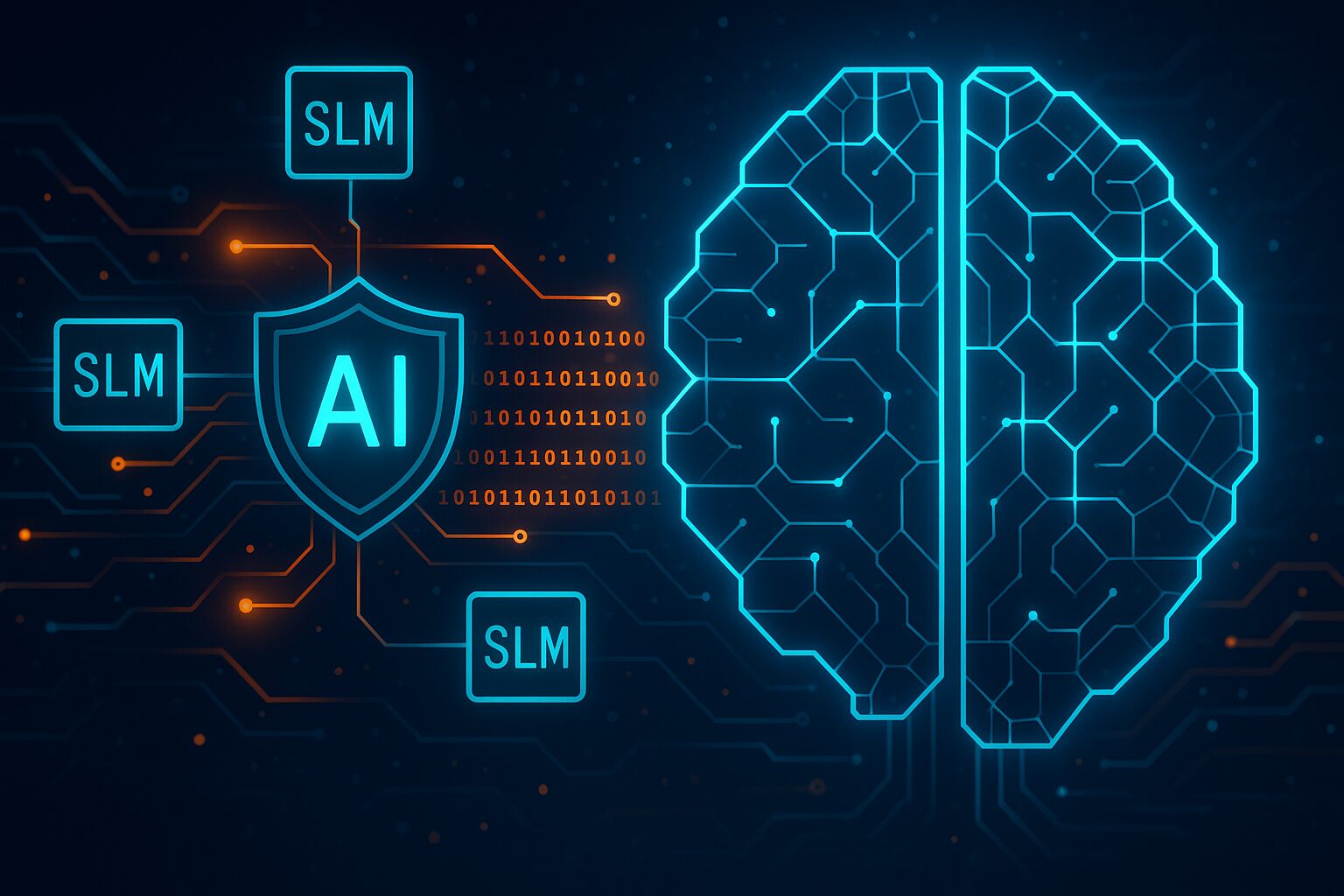
Artificial intelligence has reached an inflection point. After two years of unprecedented enthusiasm around large language models (LLMs), enterprises are now confronting the operational realities of deploying AI at scale: security risks, compliance pressure, unpredictable behavior, latency constraints and rising inference costs. A new class of models is emerging to meet these challenges — Small Language Models (SLMs).
According to Gartner, by 2027 organizations will use SLMs three times more often than general-purpose LLMs for enterprise AI workloads.
This shift is not theoretical. It is structural, economic and inevitable.
Why SLMs Are Becoming the Enterprise Default
SLMs are compact, specialized AI models designed to run efficiently — often locally, sometimes even on consumer-grade hardware. While smaller in parameter count, modern SLMs are proving capable of delivering high accuracy, lower latency and far greater controllability than their larger counterparts.
Several forces are accelerating adoption of SLMs across regulated and high-stakes industries:
These forces are not isolated trends but fundamental constraints shaping the next generation of enterprise AI.
- Security & Data Protection Requirements
LLMs typically require sending data to external cloud endpoints, exposing organizations to:
- cross-border data flows
- supply-chain vulnerabilities
- uncertain retention policies
- risks of model inference attacks
SLMs remove this barrier by running inside the enterprise perimeter, enabling:
- air-gapped deployments
- zero-trust architectures
- local inference
- complete control over logs, access, and model behavior
This makes SLMs immediately attractive for finance, insurance, critical infrastructure and government.
- Precision, Predictability, and Governance
Most enterprise tasks are not open-ended creative conversations — they are structured, repetitive and compliance-bound.
SLMs excel in these scenarios because they can be:
- fine-tuned narrowly
- behavior-aligned tightly
- audited and explained
- tested deterministically
This aligns with the rapidly evolving regulatory environment, including:
- NIST AI Risk Management Framework
- U.S. Executive Order 14110 on AI Safety
- EU AI Act
- sectoral policies in insurance, healthcare and defense
Enterprises increasingly need AI systems that can demonstrate traceability, provenance and explainability. SLMs provide that foundation.
- Cost Efficiency and Operational Scalability
Running a 70B-parameter model for high-volume workflows is rarely economically justifiable.
Modern SLMs deliver:
- 10 to 30 times lower inference cost
- reduced GPU dependence
- smaller memory footprint
- faster response times
This allows organizations to deploy AI quickly and at scale without having to build and maintain the complex, all-in-one infrastructure required by large language models. And because smaller models are significantly more efficient and easier to operate, many teams are naturally shifting toward SLMs as the more practical choice for enterprise workloads..
- Alignment With Agentic AI
As agentic systems proliferate, most tasks within these agents — tool calling, classification, extraction, verification, routing — are narrow by design.
NVIDIA research shows that well-trained SLMs now match or exceed prior-generation LLMs on tasks like:
- reasoning
- tool execution
- instruction following
- code generation
This makes SLMs not only viable for agentic architectures — but ideal.
What SLMs Unlock for Enterprise AI Security
The most transformative impact of SLMs is not performance or cost. It is security.
SLMs enable entirely new approaches to AI governance and risk mitigation, including:
- Real-time content authenticity and provenance
SLMs can inspect text, audio and metadata locally to determine whether content is human-authored or synthetic — a requirement now highlighted in multiple federal advisories.
- Deepfake-resistant communication channels
Models specialized in voice, style or identity verification can detect manipulated audio and cloned voices in seconds.
- Local AI policies and on-device enforcement
SLMs can act as the “governance firewall” — filtering prompts, blocking sensitive outputs, enforcing redactions and validating model behavior without external exposure.
- Compliance-proof AI deployments
Because they are controlled, auditable and explainable, SLMs are inherently more aligned with regulatory requirements than LLM black boxes.
This is why SLMs are gaining traction as the AI safety and verification layer across sectors where trust, confidentiality and accuracy are non-negotiable.
LLMs Still Have a Role… But a Narrower One
The future is not SLM or LLM. It’s SLM-first with selective LLM augmentation.
LLMs remain powerful for:
- broad reasoning
- open-ended research
- natural-language interaction
But for enterprise workloads, the pattern is clear:
- SLMs handle the majority of operational tasks
- LLMs are invoked only when necessary
This hybrid model ensures enterprises can benefit from advanced reasoning when necessary while maintaining strict control and predictable behavior across their day-to-day operations.
Why This Matters Now
These shifts are reshaping real-world security and regulatory landscapes.
Two conditions are converging:
- Threat actors are weaponizing AI at unprecedented scale
Deepfake impersonation, smishing/vishing, synthetic identity fraud and AI-assisted intrusion tactics are rising sharply. - Regulators are tightening expectations for AI oversight
Boards and executives now hold explicit responsibility for governing AI risk.
SLMs provide the architectural foundation for defending against these threats while meeting emerging regulatory obligations.
The Bottom Line
SLMs are not a trend.
They are the new enterprise standard for security, governance and cost-efficient AI deployment.
Organizations that embrace SLM architectures now will:
- reduce exposure
- accelerate compliance
- gain operational efficiency
- prepare for an agent-driven future
- build AI systems they can actually trust
This shift mirrors every major technology evolution of the last 20 years: From monoliths to smaller, modular, specialized, and highly-efficient systems.
SLMs are simply the next step in that progression — and they will define how enterprises adopt AI safely in the years ahead.
Why Polygraf
As the AI landscape evolves, enterprises will need more than powerful models. They will need clarity, safeguards, and the right architectural choices. Small Language Models offer a path that balances innovation with security, speed, and compliance – but realizing their full value requires experience deploying them in high-risk, tightly regulated environments.
Polygraf AI brings that depth. Our proprietary platform has been built from the ground up, around years of on-premises SLM deployment, real-time authenticity intelligence and explainable decision frameworks – long before SLMs emerged as the industry standard. We don’t just adopt SLMs; we operationalize them responsibly inside some of the most demanding security environments. For leaders intent on modernizing their AI posture without compromising trust or readiness, Polygraf stands as a capable and forward-thinking partner.
Let’s Talk
If you’re evaluating how SLMs can reinforce your organization’s security and governance strategy, this is the right moment to engage. Our team can help you assess your current AI exposure, identify where our SLMs can provide immediate risk reduction, and outline a practical, defensible path forward.





 Data Privacy
  Data Provenance
  Content Generation
  Our Solutions
  Regulations