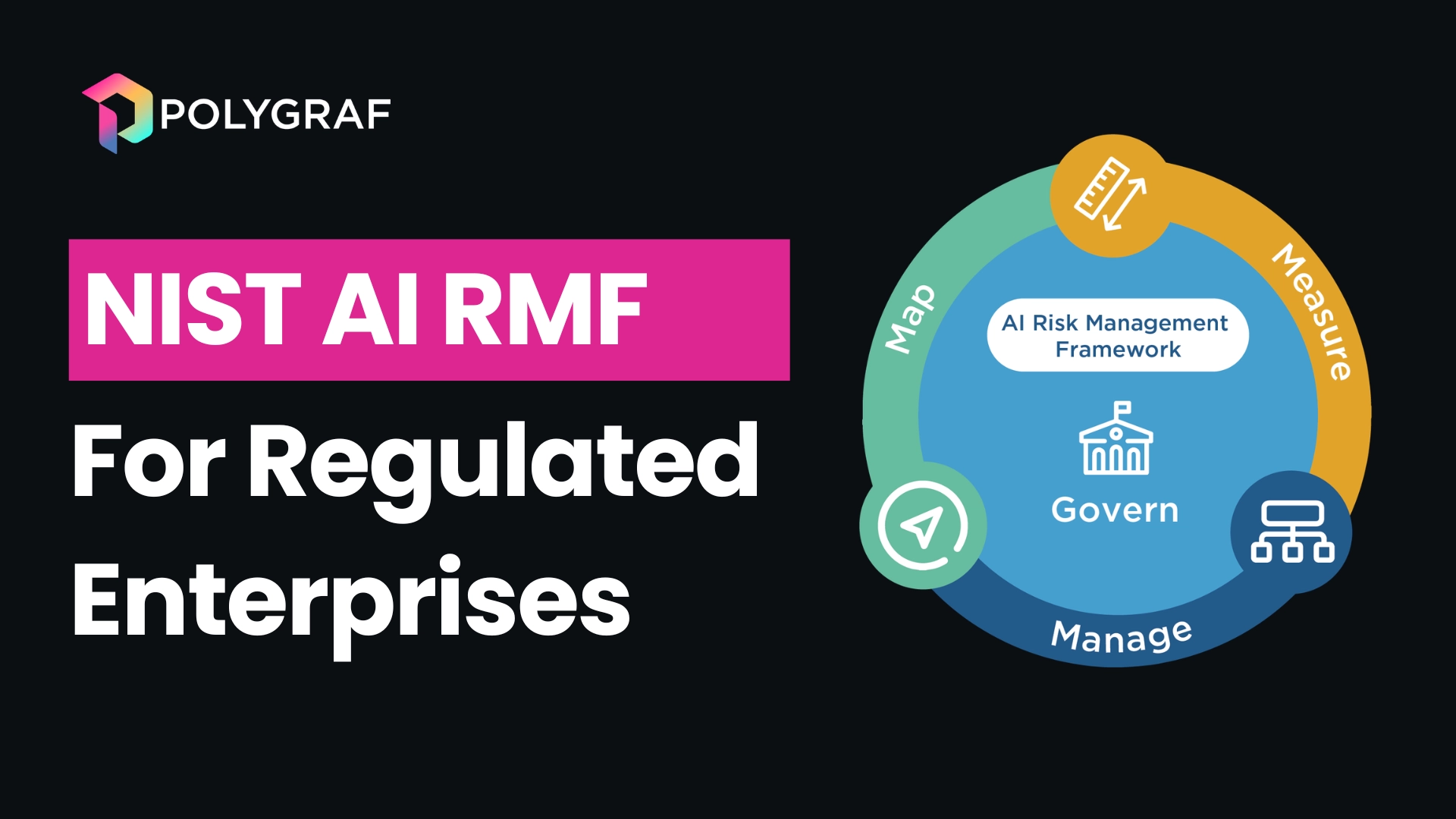


The NIST AI Risk Management Framework is voluntary – and it has quietly become the operating layer under almost every AI regulation that matters. EU AI Act, Colorado, NYC and US sector regulators all reference it. 83% of organizations are using AI, only 25% have strong governance. This is the practical guide to closing that gap with GOVERN, MAP, MEASURE, MANAGE.
Here is the paradox that defines AI governance in 2026: the single most important framework for managing AI risk in a regulated enterprise is one that no law requires you to use. The NIST AI Risk Management Framework, published in January 2023, is voluntary at the federal level — there is no NIST certification, no audit, no enforcement authority. And yet it has become the de facto standards substrate that the EU AI Act, the Colorado AI Act, NYC Local Law 144, Illinois HB 3773, and US sector regulators (FTC, CFPB, FDA, SEC and EEOC) all de facto reference when they are assessing whether a company's AI practices is a reasonable standard of care.
That makes the AI RMF the most leveraged AI governance investment you can make: implement it right and you get the documentation, controls and audit-readiness that align with almost every major AI regulatory regime at once. This is the practical implementation path – the four functions and what they need, what changes in a regulated environment in particular, the crosswalk to the regulations it covers and the phased roadmap. We build the technical controls that operationalize the data-protection and monitoring outcomes of the framework; we will show you where they go.
Three forces have made the AI RMF de facto mandatory in practice. Regulators reference its principles in enforcement guidance. Enterprise buyers put AI governance questions in their security questionnaires – organizations without a documented program will have longer sales cycles and lost deals. And cyber insurers are writing AI-specific endorsements that can exclude coverage when AI systems do not have governance controls and demonstrated NIST alignment is evidence of due diligence. Voluntary on paper, expected in the market.
AI RMF program begins with knowing where you are. Polygraf AI's AI Risk Calculator models your organization's exposure and maps which regulatory obligations (EU AI Act, sector rules, state laws) apply to you based on your industry, AI tools, data types and existing controls. It is a quick way to scope your MAP and MEASURE starting point.
The AI RMF Core arranges AI risk management into four functions (GOVERN, MAP, MEASURE and MANAGE) that are not a linear checklist but a continuous, iterative cycle. The key structural insight is: GOVERN is the cross-cutting function. It is above the other three and makes them repeatable. MAP, MEASURE and MANAGE are at the level of each individual AI system. GOVERN is at the level of the whole organization.
Hover or tap each function below to see its categories and what it needs in a regulated environment.
Beneath the four functions there is the framework's understanding of what "good" is: seven qualities that every MEASURE and MANAGE decision should be mapped back to. These are the qualities of a trustworthy AI system – and the regulators' view when they look at one.
If you deploy generative AI or LLMs, the framework has a dedicated companion: the NIST Generative AI Profile (AI 600-1), published July 2024 under Executive Order 14110.It lists 12 risk categories specific to or amplified by generative AI (confabulation, data leakage, dangerous content, etc.) and 200+ action suggestions mapped back to the four core functions. For any enterprise running LLMs the GenAI Profile is where the AI RMF becomes concrete about your real risks.
This is the strategic reason to adopt the AI RMF in a regulated company: the results of the AI RMF map to the main regulatory regimes, so a single well-designed program provides evidence for many obligations at once and not a separate project per law.
| Regulation / standard | How the AI RMF maps to it |
|---|---|
| ISO/IEC 42001 | GOVERN outcomes correspond to Clauses 4–7 (context, leadership, planning, support). Many orgs use the AI RMF as the risk operating model inside a certifiable ISO 42001 management system. |
| EU AI Act | AI RMF results are the basis of the obligations of the provider under articles 9 (risk management), 17 (quality management) and 72 (post market surveillance) and of the deployer under article 26 for high risk systems. |
| US sector regulators | FTC, CFPB, FDA, SEC, and EEOC reference framework principles when determining whether AI practices are at a reasonable standard of care. Treasury's Financial Services AI RMF (Feb 19, 2026) is NIST to 230 control objectives for banks. |
| State AI laws | The Colorado AI Act, NYC Local Law 144 and Illinois HB 3773 refer to the structure of AI RMF for risk assessment, governance and audit documentation. |
| HIPAA / GLBA | Sector data-protection rules do not mention the AI RMF, but the MAP/MEASURE/MANAGE data-governance and monitoring results implement exactly the controls that such laws impose on AI use of regulated data. |
"A well-structured AI RMF program produces documentation, control structures, and audit-readiness that map onto every major AI regulatory regime in 2026. It's the operational layer beneath compliance."
— Polygraf AI, on why the AI RMF is the highest-leverage governance investmentYou don't roll out all 72 subcategories on day one – NIST is clear that organizations roll out in increments, documenting why they are deferring work and what compensating controls and timelines they have in place. Here is a practical phasing for a regulated business.
Stand up the governance layer and see what AI you really have.
Scope risk per system and decide where to focus first.
Implement measurement and technical controls where the risk is greatest.
Make treatment, response and continuous improvement operational across the organization.
Tell your board one thing: AI RMF alignment is self-declared. There is no NIST certification or audit. An uncertified claim of alignment is less evidence – for D&O underwriting, regulatory exams and litigation – than a third-party-audited ISO/IEC 42001 certification. The practical step: use the AI RMF as your operating model, and document in such a way that it can be used to feed an ISO 42001 certification or EU AI Act conformity assessment when you need an externally validated signal. Also, be aware that NIST has indicated an AI RMF 1.1 update is in the works – document in such a way that it can absorb changes without a rebuild.
The AI RMF prescribes outcomes, not tools — and several of its most important outcomes are technical controls Polygraf AI was built for that. For MAP, our discovery is the shadow AI and embedded tools your inventory is missing. For MEASURE, we give you continuous, real-time visibility into how sensitive data is flowing through your AI systems and watch for the anomalies. For MANAGE, we enforce policy inline – detecting and redacting PII, PHI, source code and secrets at the AI edge – and give you the tamper-evident logs that document control operation. And because GOVERN's data-protection and oversight policies need a technical layer to be real, Polygraf AI is how those policies are enforced not just written. On-premise, sub-100ms, zero data egress – so the controls never become a new risk of their own.
Polygraf AI delivers the discovery, real-time monitoring, inline enforcement and audit logging that transform AI RMF outcomes (across MAP, MEASURE and MANAGE) into working technical controls. On-premise, sub-100ms, zero data egress.
At Polygraf, we envision a future where AI augments human capabilities without compromising safety, privacy, or ethical standards. Trust in our commitment to building this future with you.



© 2026 Polygraf AI. All rights reserved.
 Our Solutions
  Regulations
 Your download will start now.
Please provide information below and we will send you a link to download the white paper.
 Data Privacy
  Data Provenance
  Content Generation